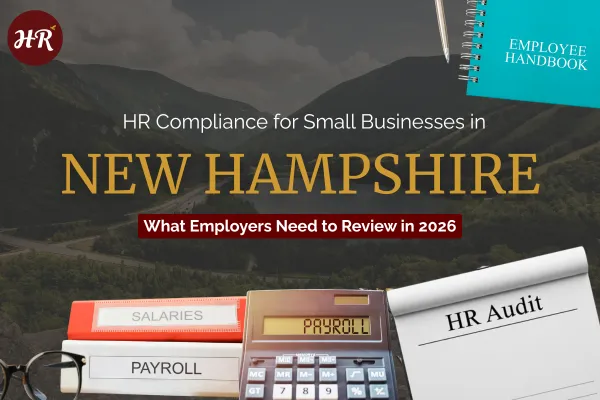
HR Compliance for Small Businesses in New Hampshire: What Employers Need to Review in 2026
Running a small business means wearing a lot of hats. HR is often one of the most important and most overlooked. It usually does not become urgent until something goes wrong, a payroll mistake, a handbook issue, a complaint, or a missed notice requirement. By then, the fix is more stressful and more expensive than it needed to be.
For small businesses in New Hampshire, HR compliance in 2026 is not about building a complicated corporate HR department. It is about making sure the basics are in place, your team knows what is expected, and your business is protected as you grow. That means reviewing your handbook, checking payroll practices, making sure your onboarding process is consistent, and keeping policies aligned with both New Hampshire and federal requirements.
This is where many employers get stuck. They know they need to clean things up, but they are not sure where to start, what matters most, or what has changed. The good news is that most compliance issues can be managed with the right systems, documentation, and support.
If you are a New Hampshire business owner, this guide will walk you through the areas worth reviewing now so you can reduce risk and build a stronger foundation for the year ahead.
Why HR compliance matters more as your business grows
When your business is small, it is easy to handle HR informally. You know everyone personally. You make decisions quickly. Policies may live in email threads, verbal conversations, or a few forms saved in a shared drive.
That approach works until it does not.
As soon as your team grows, your risk grows with it. More employees mean more hiring, more documentation, more payroll complexity, more requests for time off, and more chances for inconsistency. Even well-intentioned businesses can run into problems when practices are not documented or applied evenly.
Strong HR compliance helps small businesses:
reduce legal and financial risk
improve payroll and recordkeeping accuracy
create better employee experiences
support managers with clear guidance
build trust through consistency
prepare for growth, audits, and change
For many small businesses, compliance is not just about avoiding penalties. It is about making day-to-day people operations easier and less reactive.
What HR compliance includes for a New Hampshire small business
HR compliance is broader than many employers expect. It is not only about labor posters or payroll taxes. It includes the full structure of how your business hires, pays, manages, supports, and documents its workforce.
In practical terms, that usually includes:
Employee handbooks and workplace policies
Your handbook should reflect how your business actually operates. It should also be reviewed regularly to make sure policies are current, legally sound, and clear for employees.
Payroll practices and wage compliance
Payroll errors can create expensive problems. Employers need to review pay practices, timekeeping, classification, deductions, and required notices.
Hiring and onboarding processes
Applications, offer letters, I-9s, onboarding paperwork, and training should follow a consistent process.
Employee classification
Businesses need to be clear about who is an employee, who is exempt or nonexempt, and whether any independent contractor relationships are properly structured.
Leave administration
Time off policies, sick leave considerations, accommodations, and leave tracking all need careful attention.
Training and manager practices
Managers should understand basic expectations around documentation, performance conversations, complaints, and policy enforcement.
Recordkeeping
HR compliance depends on having the right records in the right place, retained for the right amount of time.
This is why an HR review is so valuable. It helps identify the gaps before they turn into bigger issues.
The first thing to review in 2026, your employee handbook
If your employee handbook has not been updated recently, start there.
A handbook is often one of the first places problems show up. It may refer to outdated policies, leave out current practices, or say one thing while managers are doing another. In some cases, the handbook may have been copied from another company years ago and never really tailored to the business.
For small businesses in New Hampshire, a current handbook matters because it sets expectations, supports consistent decisions, and helps employees understand how the workplace operates.
Your 2026 handbook review should include:
Core workplace policies
Make sure your handbook covers attendance, timekeeping, standards of conduct, anti-harassment, complaint reporting, technology use, confidentiality, and workplace safety.
Wage and hour language
Review sections tied to work hours, breaks, overtime, reporting time, payroll timing, and timekeeping expectations.
Leave and time off policies
Check PTO, sick time, holidays, jury duty, bereavement, parental leave, and any other leave offerings. Make sure the language is clear and reflects actual practice.
Remote and hybrid work policies
If your team includes remote or hybrid employees, your handbook should address schedules, timekeeping, availability, confidentiality, reimbursement practices if applicable, and performance expectations.
Accommodation and complaint procedures
Employees should know how to request support or report a concern, and managers should know what to do when they receive one.
At-will and acknowledgment language
Make sure handbook acknowledgments are current and signed.
A good handbook should be useful, not just protective. Employees should be able to read it and understand how your workplace works. Managers should be able to rely on it. Leadership should be confident it reflects the business accurately.
Payroll compliance in New Hampshire deserves a close look
Payroll is one of the most common areas where small employers get exposed to risk. Even a small error repeated over time can become a serious issue. In growing businesses, payroll complexity increases quickly, especially when businesses hire across state lines, add hourly roles, or change systems.
In 2026, it is smart to review payroll through both a compliance and operations lens.
Review employee classification
Are your employees properly classified as exempt or nonexempt? Are contractors truly contractors? Classification errors can affect overtime, taxes, benefits, and recordkeeping.
Confirm timekeeping practices
Hourly employees should have a reliable way to track time worked. Managers should understand how to handle edits, missed punches, travel time, and off-the-clock concerns.
Check pay practices
Review payroll timing, overtime calculations, deductions, reimbursements, and final pay procedures. Make sure your processes are consistent and documented.
Audit payroll records
Take a look at employee data, pay rates, job titles, tax settings, and state setup. Small inaccuracies in payroll systems can create larger compliance issues later.
Consider multi-state risk
If you have remote employees working outside New Hampshire, your payroll obligations may be more complicated than expected. Different states can have different rules around withholding, leave, notices, and wage compliance.
A payroll audit can be especially helpful if you have changed payroll providers, expanded into new states, hired your first remote employees, or grown quickly in the past year.
Hiring and onboarding should be consistent, not improvised
Many small businesses are so focused on filling roles quickly that hiring and onboarding become inconsistent. Different candidates get different information. Forms are completed at different times. Managers train new hires in different ways. That may feel manageable at first, but it creates risk and confusion.
A compliant and well-structured hiring process should include:
clear job descriptions
consistent interview practices
offer letters with accurate role and pay details
timely completion of onboarding forms
proper I-9 handling
payroll setup before the first pay cycle
employee handbook acknowledgment
role-specific training and onboarding steps
A strong onboarding process is not just good for compliance. It also improves retention, helps employees ramp up faster, and gives your business a more professional foundation.
For small employers, a simple onboarding checklist can go a long way. The goal is not complexity. The goal is consistency.
Remote work and multi-state teams need more structure in 2026
Remote work is no longer unusual. For many small businesses, it is part of normal operations. But remote work creates HR obligations that are easy to underestimate.
Once employees work from different locations, especially different states, your business may need to think about payroll registration, wage laws, leave requirements, posters, and policy differences. Even basic management practices need more clarity when employees are not in the same location.
This is why small businesses should review:
Remote work agreements
Do you have clear expectations around work hours, communication, equipment, confidentiality, and performance?
State-specific payroll and HR requirements
Do you know where employees are physically working, and are your payroll and compliance processes aligned with those locations?
Timekeeping for nonexempt remote employees
Do hourly remote employees have a reliable process for tracking time and overtime?
Data privacy and security expectations
Are employees trained on protecting business information while working remotely?
Reimbursement and equipment practices
Are you consistent in how you handle tools, devices, and work-related expenses?
Remote teams can absolutely be managed well. They just need stronger documentation and clearer systems than many businesses had to build before.
Manager training is a hidden part of compliance
One of the biggest compliance gaps in small businesses is not the policy itself. It is what happens when a manager has to apply it.
A handbook can be well written, but if managers do not know how to respond to attendance issues, performance concerns, accommodation requests, or complaints, the business is still exposed.
That is why manager training matters.
In 2026, small businesses should make sure managers understand:
how to document performance issues
how to respond when an employee raises a complaint
how to avoid inconsistent discipline
when to involve HR support
how to manage timekeeping and attendance properly
how to avoid making promises that conflict with policy
how to handle sensitive conversations with respect and consistency
Managers do not need to become HR experts. But they do need enough training to recognize issues early and respond appropriately.
Common HR compliance gaps small businesses should watch for
Many businesses do not have one big HR failure. They have several small gaps that build up over time. Those gaps are often easy to miss because the business is busy, people are doing their best, and no one has stepped back to assess the full picture.
Here are some of the most common issues small employers should review this year:
Outdated employee handbooks
Policies no longer match how the business operates, or the handbook has not been reviewed in years.
Missing documentation
Performance concerns, job changes, warnings, accommodations, and policy acknowledgments are not consistently documented.
Inconsistent onboarding
Different employees go through different processes, and paperwork is incomplete or delayed.
Misclassification
Roles are classified incorrectly for overtime or contractor purposes.
Weak timekeeping practices
Employees or managers handle hours informally, especially in smaller teams or remote settings.
Multi-state blind spots
The business has employees in other states but has not fully reviewed payroll or compliance obligations there.
No formal complaint path
Employees are unsure how to raise concerns, or managers are not trained on what to do when issues come up.
Reactive HR
The business only addresses HR when there is a problem, rather than reviewing systems proactively.
If any of these sound familiar, it does not mean your business is failing. It means you are in the same position many growing employers find themselves in. The key is addressing the issues before they become more disruptive.
How an HR audit helps small businesses get ahead
An HR audit is one of the best ways to move from guesswork to clarity.
For a small business, an audit does not have to be overwhelming. It is simply a structured review of the documents, processes, policies, and practices that support your team. The goal is to identify what is working, where the gaps are, and what should be prioritized next.
An HR audit can help you answer questions like:
Is our handbook current and aligned with our actual practices?
Are our payroll processes creating risk?
Do we have the right documentation in place?
Are we onboarding employees consistently?
Are our managers handling employee issues appropriately?
Are we prepared to support remote or multi-state employees?
For growing businesses, this kind of review brings peace of mind. It also makes it easier to decide what needs immediate attention and what can be improved over time.
What small businesses should prioritize first
If your HR systems feel a little messy right now, start with the areas that have the biggest impact:
1. Update your employee handbook
This is one of the clearest ways to improve consistency and reduce confusion.
2. Review payroll and classification
Make sure employees are set up properly, timekeeping is reliable, and your payroll processes match your workforce.
3. Standardize onboarding
Use a checklist and make sure all new hires go through the same process.
4. Train managers on the basics
Even a simple training process can prevent major mistakes.
5. Review remote and multi-state exposure
Know where your employees work and whether your policies and payroll setup match that reality.
6. Conduct an HR audit
A structured review can help you spot issues early and build a better plan.
FAQ: HR compliance for small businesses in New Hampshire
What is HR compliance for a small business?
HR compliance means making sure your business follows employment-related laws and maintains sound practices in areas like payroll, hiring, policies, classification, leave, documentation, and workplace conduct. For small businesses, it usually starts with the basics, a current handbook, compliant payroll practices, consistent onboarding, and clear records.
Does a small business in New Hampshire need an employee handbook?
A handbook is not just a nice-to-have. It is one of the most important tools a small business can have. A handbook helps define expectations, support consistency, communicate policies, and reduce confusion for both employees and managers.
How often should a small business update its handbook?
At minimum, review it once a year. It should also be reviewed after major business changes, such as adding remote employees, expanding into new states, changing benefits or leave policies, or updating workplace expectations.
What are common payroll compliance mistakes for small employers?
Common issues include misclassifying employees, failing to track time accurately, applying overtime rules incorrectly, missing required notices, and overlooking multi-state payroll requirements for remote employees.
What if my business has employees in more than one state?
That usually increases your HR and payroll obligations. Different states may have different requirements for withholding, leave, notices, and wage-and-hour practices. Multi-state support can help you identify and manage those differences before they create problems.
When should a small business do an HR audit?
A good time to do an audit is when your business is growing, hiring more employees, changing systems, expanding into new states, or realizing your policies and processes have not been reviewed in a while. An audit is especially useful when things feel a bit scattered and you want a clearer plan.
Can outsourced HR help with compliance?
Yes. Outsourced HR can help small businesses review policies, update handbooks, audit payroll processes, improve onboarding, support managers, and stay ahead of compliance issues without hiring a full in-house HR team.
What is the first HR compliance step to take in 2026?
For many small businesses, the best first step is a handbook and payroll review. Those two areas often reveal the biggest gaps and create the clearest path for improvement.
HR compliance does not have to be complicated, but it does need attention. For small businesses in New Hampshire, 2026 is a smart time to review the foundations, your handbook, payroll practices, onboarding, manager training, and remote work structure. Getting those pieces in place can reduce risk, support your team, and make growth a lot easier to manage.
Visit https://thebuzzhr.com/